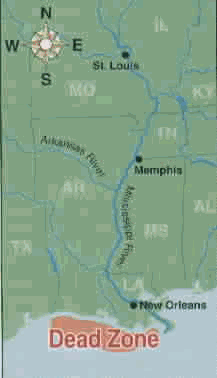
Map shows location of "dead zone" In Gulf of Mexico, an area with surplus nutrient materials that have apparently entered the gulf from the Mississippi River.
Inform, Volume 13 (February 2002): 171-172
Soapstock: new challenges, new opportunities
This article is by Ralph Daniels of Daniels AgroSciences in Sherman, Texas.
|
|
|
Map shows location of "dead zone" In Gulf of Mexico, an area with surplus nutrient materials that have apparently entered the gulf from the Mississippi River. |
The disposition of soapstock has been a problem for the oilseed industry for more than 30 years.
Since the formation of the U.S. Environmental Protection Agency (EPA) and enactment of the federal Clean Water Act in the early 1970s, the public's increasing concern for the environment has driven government to enact ever stricter regulations. Industry has the economic incentive for compliance and understands that environmental responsibility it essential to survival. A proactive environmental attitude in today’s world is considered to be good business strategy and is generally viewed positively by consumers, employees, and shareholders alike.
Nevertheless, although soapstock disposition is widely known to be a far greater problem today than ever before, industry has been slow to adopt new technologies that offer cost-effective solutions. Recent developments in environmental affairs and technology advances, however; may work in concert to speed up the process of change.
Soapstock results from the caustic refining of vegetable, marine, and animal fats and oils. Physical refining reduces the amount of waste by-products but is less efficient than caustic refining. Various uses for soapstock have been investigated, but soapstock is primarily used as an additive to meals or feeds. Many of the various uses, however, have drawbacks and may not be economically practical when compared to competing alternatives.
One means used to dispose of soapstock in the past 30 years or so has been to process it to recover the fatty acid present. The recovery process is known in the trade as acidulation because an acid, usually sulfuric, is used to split the soapstock. The splitting (acidulation) process, however, produces a large amount of effluent known as acid water—which is very high in biological oxygen demand (BOD) and chemical oxygen demand (COD) and crop nutrients, mostly phosphorus.
Phosphorus, considered a "nightmare" in effluent, has been linked to eutrophication in aquatic ecosystems, leading to an overgrowth of plants and reduced biodiversity. Most recently, nitrogen, phosphorus, and nutrients in general have been cited as primary causal agents for the environmental problems associated with hypoxia in the Gulf of Mexico and rivers in Iowa as well as the outbreaks of pfiesteria (as Pfiesteria piscicida), a toxic free-swimming single celled organism that has been associated with lesions and death of fish in the Chesapeake Bay and eastern seaboard from Pennsylvania to Florida.
Hypoxia, pfiesteria, and nutrient management are among the most important environmental issues facing the United States and world today. The oilseed industry may not be fully aware of its role and responsibilities in relation to this problem. In the Gulf of Mexico is an area known as the "Dead Zone." It lies just off the coast of Texas and Louisiana and covers 8,000 square miles, an area slightly larger than the state of New Jersey. The Dead or Hypoxic Zone is caused by excess nutrients in the water. Vast blooms of algae deplete so much oxygen that nothing can live there - a condition called hypoxia. The nutrients (primarily nitrogen and phosphorus) responsible for creating the Dead Zone are carried to the Gulf by the Mississippi River. White House task forces have been targeting fertilizer runoff from Midwestern farms as a major source of nutrients and suggesting a 20% reduction in fertilizer use as one possible solution.
Soybeans, corn, and other oilseeds contain high levels of phosphorus by virtue of its natural presence in phosphatides (phospholipids). Hydratable and nonhydratable (complexed with calcium and magnesium) phospholipids are known in the oilseed processing industry as lecithins or gums. Both forms are removed during oil refining, together with the phosphoric acid that is added to facilitate removal of the nonhydratables. All the phosphorus ends up in the soapstock created in the refining process.
Soapstock represents about 5% of refining throughput. Put another way, the phosphorus that is present in crude oil is concentrated in the soapstock by a factor of 20. When soapstock is acidulated to recover fatty acids, the phosphorus is further concentrated by a factor of 2. The phosphorus concentration in acid water (effluent) is 40 times higher than the level in crude vegetable oil. A single large soybean oil refinery operating at 150,000 lb/hr will produce approximately 900,000 lb (at 100% i.e., 0—100-0) of fertilizer phosphorus (P2O5; phosphorus pentoxide) each year. Garden and professional water-soluble fertilizers typically contain P2O5 levels in the 5% range. Viewed from this perspective, the effluent from that one soybean refinery produces enough phosphorus to produce 18,000,000 lb of fertilizer, or 360,000 50-lb bags, which, if laid end to end, would go a long way toward lining one bank of the Mississippi from Memphis to New Orleans!
Can you imagine the public reaction if an environmental activist group, such as Greenpeace, were to dramatize the situation by parking a barge piled high with 360,000 bags of fertilizer on the Mississippi River at Memphis, then pouring the contents (bag by bag) into the river in order to demonstrate the magnitude of one refinery’s contribution to the excess nutrient load in the Gulf of Mexico?
The previous paragraph is meant to dramatize both the problem and the practicality of the solution. The phosphorus and other nutrients naturally present in all oilseeds, crude vegetable oils, and soapstocks can be perceived either as problems when discharged as effluent or as commercially valuable products when utilized as crop fertilizer. In order to make use of the indigenous nutrients, two simple changes are required.
First, the usual caustic refining agent, sodium hydroxide (caustic soda) must be replaced by potassium hydroxide (caustic potash). This will result in potassium soapstock and potassium, a primary plant nutrient, in the acid water in place of sodium. After potassium soapstock is split via traditional acidulation, the second change is to neutralize the resultant acid water (which will contain potassium ions) with ammonia or ammonium hydroxide. When neutralized with ammonia (83% nitrogen) or ammonium hydroxide (aqua ammonia, 28% nitrogen), the solution becomes enriched with nitrogen, yet another primary plant nutrient. The resultant solution (which in the traditional process would be acid water) is a complete liquid multinutrient plant food that contains the three primary plant nutrients, N-P-K (nitrogen-phosphorus-potassium). All the problems associated with nutrients in effluent disappear completely. The process, as carried out in this manner, is known as the Daniels Fertilizer Process and was patented in the United States and many foreign countries in 1989-94. The challenges posed by new environmental emphasis on nutrient manage be completely ameliorated by adoption of this process. The process was commercialized beginning in 1995 by Agrotech of Sherman, Texas (Inform 6:421-423, 1995).
Scientific studies have demonstrated that refining with potassium hydroxide will produce an oil of higher quality and at lower cost than oils refined with sodium hydroxide. Daniels Plant Food has pioneered the commercialization of "oilseed extract," as the new multinutrient fertilizer is officially known. The product (made from oilseed extract) is registered for sale U.S. states and Canada. It is used in floriculture, horticulture, and the cultivation of agricultural crops, and scientific research has documented the validity of various value-added crop responses.
So, coming full circle, the natural nutrients extracted and released during oilseed crushing that are targeted for removal by refiners as undesirable constituents in edible oils can be thought of as high BOD and phosphorus loads in effluent that contribute to such environmental problems as hypoxia. In the alternative use described, they can be viewed as natural and renewable feedstocks that make use of compounds in oilseeds that are extracted during crush and refining and that can be exploited to improve refining economics, agricultural economics, and the environment.
Readers may contact the author at Daniels AgroSciences, P.O. Box 1224, Sherman, TX 75091-1224, (phone: (903) 891-7241); email: info@danielsagrosciences.com)